Beyond the Brochure Map: Auditing EV Charging in Flats and New-Build Estates
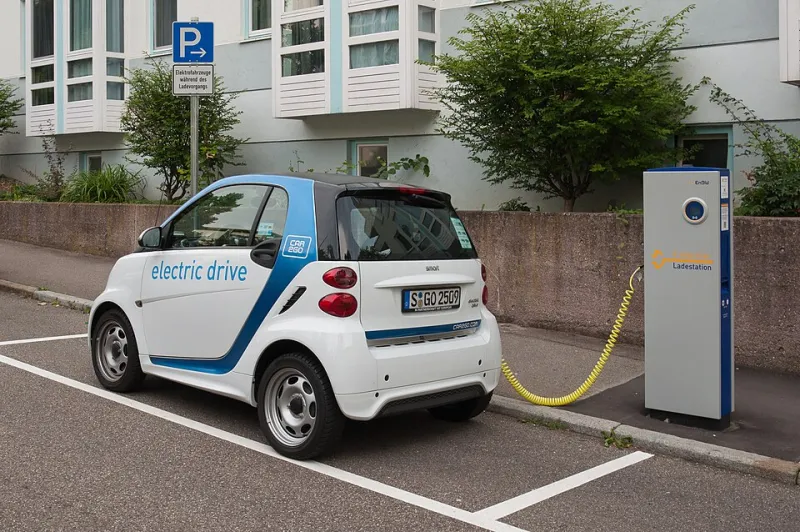
Photo: Julian Herzog (Website), CC BY 4.0, via Wikimedia Commons
An electric-vehicle charging point is easy to draw on a site plan. A single symbol near the entrance of a new estate can suggest that the infrastructure question has been answered. In practice, the useful questions begin where the brochure stops: which bay is served, who owns the equipment, what happens when several residents charge at once, and who pays for maintenance over the life of the building.
From a postcode marker to a usable parking bay
A charging marker on a map is not a service. It may denote a public rapid charger on the estate edge, a single communal post in a visitor bay, or a private unit attached to one house. Buyers and renters should establish the exact location, the number of connectors, the charging speed, whether cables are tethered, how payment is made and whether access is restricted. A charge point that is available only to visitors, or that sits on a public highway, does not solve the overnight charging needs of residents.
For flats, the relevant question is often whether a specific parking space is allocated and whether the lease or tenancy gives the occupier the right to use it for charging. For new-build estates, ask whether the charging provision is part of the adopted public realm, a management company asset, or private equipment.
Ownership, consent and transferability
Ownership should be established before exchange or signature. Is the charge point owned by the freeholder, the management company, a residents’ association or an individual leaseholder? If it is communal, what legal arrangement governs its use? If it is private, can it be assigned with the property or the tenancy? For leasehold buyers, the lease and any licence for alterations are central. Installing or replacing a charge point may require landlord consent, and the route of cabling can affect communal areas.
Renters should ask whether the landlord has permission to provide the charge point, whether the equipment is included in the tenancy, and what happens if it fails. A charging facility that depends on an informal arrangement can disappear when the landlord or managing agent changes.
Capacity and load management
The electrical capacity of a block or estate is a practical constraint that brochure maps rarely show. A development may have enough supply for a handful of charge points but not for every resident charging overnight. Ask for the electrical capacity assessment and the load-management strategy. Does the system throttle charging automatically? Is there a booking arrangement? Are there spare ways in the distribution board? Has the local distribution network operator been consulted?
These questions matter more as uptake rises. A scheme that works for early adopters may become congested later, and retrofitting additional capacity can be expensive. Buyers should also ask who is responsible for future upgrades and whether the service charge or reserve fund is intended to meet that cost.
Service charges, maintenance and software
Communal charging brings communal costs. Electricity for communal bays, maintenance contracts, insurance, payment back-office systems and software subscriptions may all be recoverable through a service charge. Ask for the relevant budget line and any reserve-fund provision. For renters, check whether charging costs are included in the rent, recovered separately or paid through an app.
Software is another dependency. A charge point that relies on a discontinued app or an unsupported payment platform can become inconvenient even if the hardware still works. Ask about the operator, the contract term and the process for switching provider. The most robust arrangements are usually those with clear maintenance responsibilities and a documented route for replacement.
Upgrade rights and building governance
Future-proofing is partly a legal question. Can the management company add charge points to communal areas? Can leaseholders request an allocated point? Is there a policy on cable routing, floor boxes and fire safety? For major works, the usual leasehold consultation process may apply, and the answer will depend on the lease and the managing agent’s approach. A buyer should not assume that a ‘right to charge’ exists simply because a charge point is present today.
A practical checklist
- Identify every charge point on the site and distinguish public, communal and private equipment.
- Confirm the parking bay, access arrangements and whether use is allocated or shared.
- Establish ownership and the legal basis for use, including any licence or wayleave.
- Ask whether the equipment transfers with the property or tenancy.
- Request the electrical capacity assessment and load-management details.
- Check charging speed, connector type, tethered cable and payment method.
- Review service-charge budgets for electricity, maintenance, insurance and software.
- Ask about warranties, maintenance contracts and the process for reporting faults.
- Confirm future upgrade rights and any consent process for additional points.
- Check whether a single brochure marker represents a usable resident service or only a public postcode amenity.
For buyers and renters alike, the test is not whether a development mentions electric vehicles. It is whether the infrastructure is usable, assignable, affordable and maintainable. A charging column can add genuine convenience to connected living, but only when the legal and practical arrangements behind it are as solid as the post it stands on.