Shade, Vent and Verify: Auditing Summer Comfort in a Connected Flat
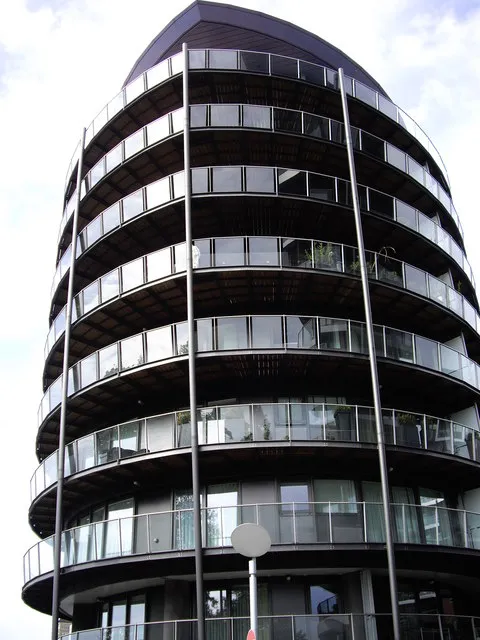
Photo: PAUL FARMER, CC BY-SA 2.0, via Wikimedia Commons
As the UK moves through winter 2026, summer heat may feel like a distant concern. For anyone buying or renting a flat, however, the coming warm season is a due-diligence issue that is easier to examine now than during a July heatwave. Brochures for connected blocks increasingly promise climate comfort through automated blinds, mechanical ventilation and app-controlled cooling. Those systems can be useful, but they are rarely subjected to the same scrutiny as kitchens, bathrooms or broadband. A flat that performs well on a mild viewing day may still overheat when solar gain, occupancy and weak purge ventilation combine.
Begin with the building envelope
Summer comfort is determined first by the building, not the control panel. Orientation, glazing ratio, balcony depth, internal layout and the presence of external shading all matter more than whether a blind can be operated from a phone. Ask for the overheating assessment prepared for the building and, where relevant, for the specific flat. In England, Building Regulations Part O addresses overheating in new residential buildings, and assessments are commonly informed by TM59 methodology. These documents are not a guarantee of comfort in every unit, but they should show the assumptions used: window openings, shading coefficients, occupancy patterns and whether windows can be opened safely.
A south- or west-facing flat with floor-to-ceiling glazing and no external shading deserves particular attention. Internal blinds can reduce glare, but they are generally less effective than external shading at stopping solar gain before it enters the room. Check whether the flat is dual aspect, whether cross-ventilation is possible, and whether openable windows are constrained by noise, security or pollution. A smart system may mask a fundamental design weakness; it does not remove it.
What the shading is actually doing
Automated blinds are often described as a climate-comfort feature. The useful questions are more practical. Are the blinds internal or external? Are they powered by batteries, low-voltage wiring or mains electricity? What happens on power failure or loss of network connection? Can they be operated manually, and are the controls accessible to someone with limited mobility? External shading is exposed to wind and rain, so its fixings, warranty and maintenance regime matter.
Ask for commissioning records and a demonstration. A blind that closes at midday may be responding to a sensor, a schedule or a default setting; the difference affects both comfort and energy use. Check where sensors are placed and whether they are shaded, dusty or affected by direct sun. Confirm whether the blinds are part of the landlord’s or building safety regime, particularly if they affect means of escape or access to windows. For leaseholders, the lease and service-charge budget should clarify who repairs motors, replaces batteries and maintains shared controls. A climate-control subscription that looks modest at handover can become a recurring cost if software support is time-limited.
Ventilation is not the same as cooling
Mechanical ventilation with heat recovery can provide fresh air and help remove stale air, but it is not air conditioning. Ask what the system is designed to do in summer. Does it offer a bypass mode? Can it purge heat at night? What is its noise level at the speeds needed for summer operation? Are filters accessible from within the flat, and how often must they be changed? Automated vents and louvres require their own checks: actuators fail, insect screens clog and controls can be locked to a central building system.
Where a flat is marketed with cooling, establish what is actually installed. A portable unit, a ceiling cassette or a shared district cooling connection each carries different obligations. Check the lease, service charge and planning position before assuming that additional cooling equipment can be installed later. In listed or conservation-area buildings, external shading and condenser units may require consent. The smartest option is often the least glamorous: effective external shading, controllable purge ventilation and a realistic understanding of how the flat will be used.
The service-charge layer
Connected comfort systems create ongoing liabilities. Shared blind controls, central ventilation plant, sensors and software platforms may sit within the service charge. Ask for the current budget, any reserve-fund provision for replacement, and the operation and maintenance manuals. Confirm the expected service life of motors, sensors and controllers. If a central system fails, who is responsible for repair, and what interim measures are available? A leaseholder may have limited ability to replace shared equipment independently.
Prospective tenants should ask similar questions, even if the service charge is not paid directly. Request a demonstration of the controls, check whether the landlord or managing agent provides instructions, and ask how faults are reported. The tenancy agreement should make clear who is responsible for filters, batteries and minor repairs.
A practical pre-exchange audit
Before committing, request the overheating assessment, the shading specification, commissioning records and the relevant O&M manuals. Visit on a sunny day if possible, or ask for summer operating logs and fault records. Test manual overrides, check that windows open as described, and confirm that controls are not locked to a builder-only app. Review the service-charge budget for maintenance and replacement of comfort systems. Finally, take professional advice where the documentation is incomplete. Summer comfort is not a brochure aesthetic; it is a building-performance issue with maintenance and financial consequences. Auditing it before exchange is the most reliable way to avoid discovering the cooling clause in August.